Source Environmentally Friendly Outdoor Kitchen Cabinets for BBQ, Home, and Outdoor BBQ
Compare 30 listings for Environmentally Friendly Outdoor Kitchen Cabinets designed for home, outdoor BBQ, and kitchen cooking applications. These units feature customizable sizes, modern designs, and materials like granite and stainless steel to suit various sourcing needs.
Key considerations
Products List


Weatherproof Modular Outdoor Kitchen with Integrated Sink & Storage Cabinets
$120.00 - $160.00
MOQ: 1 Pieces


Freestanding Outdoor Stainless Steel Kitchen Cabinet with Stove Outdoor Furniture
$20.00 - $26.00
MOQ: 20 Square Feet

Custom Outdoor Furniture Stainless Steel Kitchen Cabinets Garden BBQ Kitchen
$12.00 - $16.00
MOQ: 20 Square Feet

Wholesale Custom Freestanding Outdoor Stainless Steel Kitchen Cabinet
$22.00 - $26.00
MOQ: 20 Square Feet

Black Color Outdoor Stainless Steel Kitchen Cabinet with Stove Waterproof Kitchen
$24.00 - $28.00
MOQ: 20 Square Feet

Garden BBQ Kitchen Outdoor Stainless Steel Kitchen Cabinet Black Color
$15.00 - $19.00
MOQ: 20 Square Feet


Factory Custom Outdoor Kitchen Cabinet for Outdoor Living with Modular Design
$5300.00 - $5800.00
MOQ: 1 Pieces
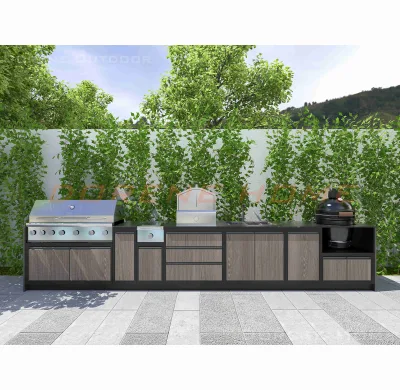
Comprehensive Sourcing Guide
Sourcing Strategy for Environmentally Friendly Outdoor Kitchen Cabinets
The global shift toward sustainable outdoor living has elevated the demand for Environmentally Friendly Outdoor Kitchen Cabinets. Buyers seeking these solutions must navigate a complex landscape where "eco-friendly" is often a marketing term rather than a verified specification. This guide provides a disciplined approach to sourcing, focusing on verifiable material composition, structural integrity, and compliance standards. The objective is to equip procurement professionals with the knowledge to distinguish between genuine sustainable products and those with superficial green claims, ensuring long-term value and environmental responsibility.
Material Composition and Environmental Impact
The foundation of any environmentally friendly cabinet lies in its material composition. In the context of outdoor kitchen units, the primary materials observed in the market include molded board, metallic board, and plywood. For a product to be considered environmentally responsible, the sourcing of these materials must be traceable and the manufacturing process must minimize waste and toxic emissions.
Plywood, specifically noted in available product data as a carcase material, offers a viable alternative to solid wood or particle board. When sourced responsibly, plywood utilizes wood fibers efficiently, reducing the volume of raw timber required. However, the environmental impact of plywood is heavily dependent on the adhesives used in its lamination. Buyers must verify that the bonding agents are formaldehyde-free or meet low-emission standards such as E0 or E1. The presence of "Molded Board" and "Metallic Board" for doors suggests a composite approach. While these materials can be durable, their recyclability and the energy intensity of their production vary significantly.
Granite is also observed as a table material in related outdoor kitchen contexts. While natural stone is durable and long-lasting, its extraction and transportation have a high carbon footprint. For a truly sustainable profile, buyers should prioritize locally sourced stone or verify if the granite is a byproduct of other quarrying operations. The combination of these materials—plywood carcasses, composite doors, and stone tops—requires a holistic assessment. The buyer must ensure that the "Metallic Board" or "Molded Board" does not contain volatile organic compounds (VOCs) that could degrade indoor or outdoor air quality.
Structural Specifications and Durability Standards
Durability is a critical component of sustainability; a cabinet that fails prematurely requires replacement, generating waste and additional resource consumption. The structural specifications of outdoor kitchen cabinets must withstand harsh environmental conditions, including moisture, UV radiation, and temperature fluctuations.
Product data indicates specific dimensions such as 600600870mm, which serve as a baseline for standard sizing. However, the trend toward "Customize" sizes and "made your order" specifications allows for optimized material usage, reducing off-cuts and waste during production. The "Hidden Drawer" guide rail kind and "Steel Pump" mechanisms observed in the inventory suggest a focus on precision engineering. These components must be corrosion-resistant, particularly for outdoor applications where humidity is a constant factor.
The load capacity is another vital specification. Data points to a maximum load capacity of 70 Kg for intermediate shelves. This figure provides a concrete benchmark for structural integrity. Buyers should verify that the actual load-bearing capacity of the specific model they are sourcing meets or exceeds this standard, especially if the cabinets are intended for heavy cooking equipment or storage. The "Fixed" versus "Unfixed" attribute highlights the importance of installation stability. For outdoor settings, a "Fixed" configuration often provides better resistance against wind and seismic activity, whereas "Unfixed" units may require additional anchoring to ensure safety.
Compliance, Certification, and Safety Verification
Navigating the certification landscape is essential for validating environmental and safety claims. The market data reveals the presence of CE and ISO certifications. The CE mark indicates conformity with health, safety, and environmental protection standards for products sold within the European Economic Area. The ISO certification, often paired with CE, suggests adherence to international management system standards, which can include environmental management (ISO 14001).
However, the presence of these certifications on specific listings must be verified against the actual product batch. The data also lists "FSC" as a low-confidence background item. While the Forest Stewardship Council (FSC) is a gold standard for sustainable forestry, its mention here is not a confirmed attribute of the supplied products. Buyers should not assume FSC certification exists without requesting specific documentation. Instead, the focus should remain on the confirmed CE and ISO marks, ensuring they apply to the specific manufacturing facility and product line.
Safety devices are also a critical compliance area. The observed "Flame Safety Device" and "Gas Grills" integration highlight the need for strict adherence to gas safety standards. For outdoor kitchens, the integration of LPG fuel systems requires rigorous testing to prevent leaks and explosions. Buyers must ensure that the "Safety Device" is not merely a feature but a certified component that meets local fire codes. The "Not Coated" finishing process observed in some listings may present a challenge for outdoor durability, as lack of coating can lead to faster degradation of the underlying material.
Cost Drivers and Pricing Dynamics
Understanding the cost drivers for Environmentally Friendly Outdoor Kitchen Cabinets is crucial for budgeting and value assessment. The observed price range in the market spans from 12 to 8100 USD, a variance that reflects differences in material quality, customization levels, and certification status.
The primary cost driver is the material selection. Plywood and granite are generally more expensive than standard particle board or plastic composites due to their durability and sourcing requirements. Customization, indicated by "Customize" size and "Surface Finish" options, adds significant labor and material costs. The "Plywood Case" and "Standard Export" packing methods also influence the final price, as robust packaging is necessary to prevent damage during international shipping.
The MOQ (Minimum Order Quantity) range of 1 to 20 units offers flexibility for buyers. Lower MOQs allow for smaller batch testing but may result in higher per-unit costs due to setup fees. Conversely, larger orders can leverage economies of scale. Buyers should be wary of prices that seem too low, as they may indicate the use of non-compliant materials or a lack of necessary certifications. The "Modern" and "Island Style" attributes suggest a premium design element, which often commands a higher price point compared to basic "Linear Style" units.
Supplier Evaluation and Production Capabilities
Evaluating suppliers requires a deep dive into their production capabilities and transparency. The data indicates that the "Factory" and "prod_origin" are located in China. While this is a major manufacturing hub, it necessitates rigorous due diligence regarding labor practices and environmental regulations at the source.
Buyers should verify the supplier's ability to handle "Customized" orders effectively. The presence of "Made your order" specifications suggests a flexible manufacturing process, but the buyer must confirm the supplier's capacity to maintain quality control during customization. The "New" condition of the products implies that the supplier is actively producing current models, but the buyer should request evidence of recent production runs to ensure the products are not obsolete stock.
The "Standard Export" packing and "Plywood Case" options indicate that the supplier is experienced in international logistics. However, buyers should verify the specific packaging standards to ensure they meet the environmental requirements of the destination market. For instance, some regions have strict regulations on wood packaging materials (ISPM 15), which requires heat treatment or fumigation. The supplier must be able to provide proof of compliance with these international shipping standards.
Quality Control and Long-Term Procurement Considerations
Quality control (QC) is the final gatekeeper in the procurement process. For outdoor kitchen cabinets, QC must focus on water resistance, UV stability, and mechanical durability. The "Modern Design" and "Easy to Use" attributes are subjective, but they rely on the objective quality of the "Drawer Guide Rail Kind" and "Pull Basket" mechanisms.
Buyers should implement a multi-stage QC process. First, verify the material certificates for plywood and composite boards. Second, conduct physical testing on the "Steel Pump" guides and "Hidden Drawer" mechanisms to ensure smooth operation under load. Third, inspect the "Surface Finish" to confirm it is suitable for outdoor exposure. The "Not Coated" finish observed in some listings is a red flag for outdoor use unless the material itself is inherently weather-resistant.
Long-term procurement considerations involve the lifecycle of the product. The "Multi-Layer Pull Basket" and "Trolley" features suggest a focus on functionality and storage efficiency. However, the environmental impact of these components must be assessed. Are they recyclable? Can they be easily replaced if they break? The "Optional" type attribute indicates that buyers can select configurations that minimize waste.
Comparative Analysis of Product Attributes
To facilitate decision-making, the following table compares key attributes observed in the market data, highlighting the trade-offs between different product configurations.
| Attribute Category | Option A: Standard Configuration | Option B: Customized Configuration | Option C: Premium Outdoor |
|---|---|---|---|
| Material | Plywood Carcase, Molded Board | Custom Size, Custom Finish | Plywood, Metallic Board, Granite |
| Style | Linear Style, Aisle Style | Island Style, Custom | Modern Design, Trolley |
| Certification | CE, ISO | CE, ISO | CE, ISO, (Verify FSC) |
| Drawer Guide | Hidden Drawer, Steel Pump | Customizable | Multi-Layer Pull Basket |
| Load Capacity | 70 Kg (Intermediate Shelf) | Variable based on design | 70 Kg + Reinforced |
| Packing | Plywood Case, Standard Export | Cardboard and Wooden Boxes | Standard Export |
| Finish | Not Coated (Verify) | Custom Surface Finish | Coated for Weather |
This comparison illustrates that while standard configurations offer cost savings, customized and premium options provide better alignment with environmental and durability goals. The "Not Coated" finish in standard options requires careful evaluation to ensure it meets outdoor durability standards.
Conclusion
Sourcing Environmentally Friendly Outdoor Kitchen Cabinets requires a meticulous approach that prioritizes verified material data, robust structural specifications, and confirmed certifications. The market offers a wide range of options, from basic linear units to complex island configurations, but the buyer must look beyond marketing claims. By focusing on the tangible attributes such as plywood carcase quality, CE/ISO compliance, and load capacity, procurement professionals can ensure they are investing in products that are both sustainable and durable. The journey from a 12 USD basic unit to an 8100 USD custom installation involves significant differences in material integrity and environmental impact. Ultimately, the goal is to select a supplier who can demonstrate transparency in their manufacturing process and provide verifiable evidence of their environmental commitments.
FAQs
What certifications do Environmentally Friendly Outdoor Kitchen Cabinets have?
These cabinets typically hold CE and ISO certifications to ensure safety and quality standards. Buyers should verify that these marks apply to the specific product batch and manufacturing facility before purchasing.
Which materials are used for the carcase and doors of these units?
Common materials include plywood for the carcase and molded or metallic board for the doors. Buyers must verify that adhesives used in plywood meet low-emission standards to ensure environmental safety.
Can the size and surface finish of these cabinets be customized?
Yes, customization is available for size and surface finish to meet specific order requirements. This flexibility allows for optimized material usage but may increase production costs and lead times.
What is the maximum load capacity for the intermediate shelves?
The observed maximum load capacity for intermediate shelves is 70 Kg. This figure serves as a benchmark for structural integrity when selecting units for heavy cooking equipment storage.
How are these cabinets packed for international shipping?
Packing options include plywood cases, standard export packaging, or cardboard and wooden boxes. Robust packaging is essential to prevent damage during transit and must comply with international wood treatment standards.
Where are the factories producing these outdoor kitchen cabinets located?
The factories are located in China, which is a major manufacturing hub for this equipment. Buyers should conduct due diligence on labor practices and environmental regulations at the source facility.
What safety devices are integrated into the gas grill components?
Safety devices such as flame safety devices are integrated into the gas grill systems. These components must be certified to meet local fire codes to prevent leaks and explosions during outdoor use.